
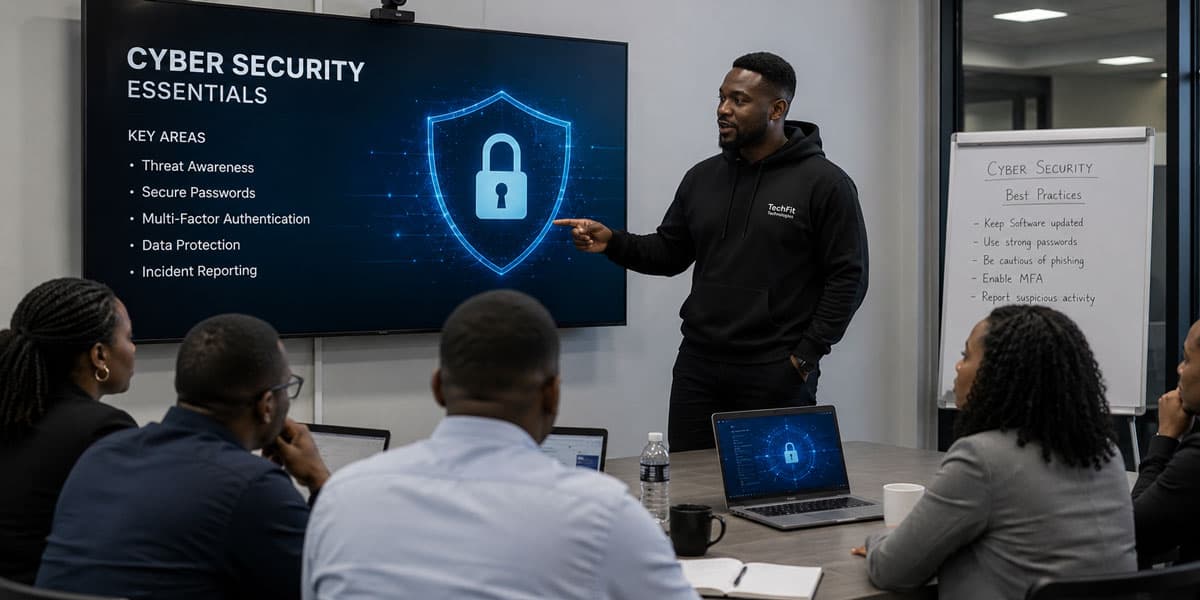
One careless click is often all it takes. For South African SMMEs, that could mean stolen data, disrupted operations, lost money, and a damaged reputation. Cybersecurity awareness workshops help businesses reduce that risk by turning employees into the first line of defence instead of the weakest link.
At Tech-Fit Technologies, we believe the best defence starts with people, not just software. That is why cybersecurity awareness workshops are one of the most practical investments a South African SMME can make to strengthen resilience, protect customer data, and reduce everyday risk.
Why South African SMMEs Are at Risk
South African SMMEs contribute an estimated 40% to 47% of the country's GDP and support millions of jobs, which makes them essential to the economy. It also makes them attractive targets, since criminals know that smaller businesses tend to have weaker defences and fewer dedicated IT resources than larger corporates.
The numbers back this up. Recent industry research found that one in two South African organisations experienced a cybersecurity incident or data breach in the past year, despite the country recording some of the highest cybersecurity investment intentions globally, a resilience gap between buying security tools and actually embedding them into daily operations. Separately, the CSIR estimates that cyberattacks cost South African organisations roughly R2.2 billion every year, a figure that includes SMMEs who often have the least room to absorb that kind of loss.
South Africa's high cybercrime exposure isn't a large-enterprise problem. It's a business problem, and it lands hardest on the businesses least prepared to recover from it.
The Real Problem: It Usually Starts With People
Most cyber incidents do not begin with advanced hacking tools. They begin with ordinary human behaviour, someone clicking a malicious link, opening a dangerous attachment, or approving a fraudulent payment request because it looked legitimate enough not to question.
This isn't a fringe issue. Analysis of local data breaches shows that human error is linked to the vast majority of incidents in South Africa, through accidental data leaks, weak passwords, and successful phishing attempts. Academic research on South African SMMEs, including studies from UNISA, points to the same conclusion: smaller businesses are especially vulnerable because they often lack in-house IT skills and dedicated security budgets, and cybersecurity awareness training is one of the few controls that protects the entire business at once.
That is why awareness workshops work. They teach staff how to recognise suspicious messages, verify unusual requests before acting on them, protect passwords properly, and report threats quickly instead of quietly hoping the problem goes away.
What a Cybersecurity Awareness Workshop Teaches
A practical cybersecurity workshop goes beyond theory. It shows staff how attacks actually happen and what to do in real situations, which matters most in a small business environment where people often wear multiple hats and don't have an IT department to fall back on.
A good workshop typically covers:
- Phishing and email scams
- Fake invoices and payment fraud
- Password hygiene and multi-factor authentication
- Safe use of devices, Wi-Fi, and company data
- How to report suspicious activity fast
- POPIA-related awareness and basic data handling
When teams understand these threats in plain language, they make far fewer avoidable mistakes. More importantly, it builds a culture where security becomes part of everyday business practice, not a once-off compliance exercise that gets forgotten by the following week.
Why This Matters for Business Continuity and POPIA
For many SMMEs, cybersecurity budgets are tight, which is exactly why awareness training is so valuable. It offers a high-impact way to reduce risk without a major technology overhaul. A few focused hours of training can help prevent incidents that would otherwise lead to lost revenue, downtime, recovery costs, and reputational damage that's much harder to rebuild than to protect in the first place.
There's also a compliance angle that South African businesses can't ignore. Any business that handles personal information has obligations under the Protection of Personal Information Act (POPIA), enforced by South Africa's Information Regulator. Awareness training helps employees understand how to handle customer and staff data responsibly day to day, which means a well-run workshop supports both security and POPIA compliance at the same time.
How Tech-Fit Helps SMMEs Stay Protected
Tech-Fit Technologies offers cybersecurity awareness workshops built specifically for South African SMMEs. The focus is practical, not technical jargon, so your team leaves with simple, actionable habits they can apply immediately, not a slide deck they'll never look at again.
If your business has never run a formal awareness session, or your staff training is outdated, a workshop is a smart place to start. It gives your team the confidence to spot scams earlier, respond faster, and help protect the business from incidents that were entirely preventable.
If you'd like to talk through what a workshop would look like for your team before committing, you're welcome to get in touch first.
Book Your Cybersecurity Workshop
Ready to improve your team's cyber awareness? Book a cybersecurity workshop with Tech-Fit Technologies and give your staff the tools to recognise threats before they become business problems.
Related Articles
 Cybersecurity
The Phone Scam South Africans Are Falling For: How Vishing Works and How to Stop It
Vishing, or voice phishing, is one of South Africa's fastest-growing cybercrimes. Here is how the phone scam works, why it is so effective, and exactly how to protect yourself and your business.
Read Article Cybersecurity
10 Cybersecurity Mistakes South African Small Businesses Make (And How to Fix Them)
South African small businesses are increasingly targeted by cybercriminals. Here are the 10 most common cybersecurity mistakes, and exactly how to fix each one before it costs you.
Read Article