
South Africa is one of the most targeted countries in the world for cybercrime. According to recent reports, the country loses billions of rands annually to cyber attacks, and small businesses are increasingly in the crosshairs. Why? Because cybercriminals know that small businesses have valuable data but often lack the security measures of larger corporations.
The good news is that most cyber attacks succeed because of avoidable mistakes. Here are the 10 most common ones South African small businesses make, and exactly how to fix each one.
Mistake 1, Using Weak or Reused Passwords
This is still the number one entry point for attackers in 2026. If your password is your business name, your phone number, or the word "password123," you are one automated attack away from a serious breach.
The fix: Use a password manager like Bitwarden (free) or 1Password. Generate unique, complex passwords for every account. Enable two-factor authentication (2FA) on every platform that supports it, especially email, banking, and social media.
Mistake 2, No Employee Cybersecurity Training
Your technology can be perfect and one click from an untrained employee can still bring everything down. Phishing emails, where criminals impersonate trusted organisations to steal credentials, are responsible for over 80% of data breaches.
The fix: Train your staff. They do not need to become IT experts but they need to know how to spot a suspicious email, why they should never click unknown links, and what to do if something looks wrong. Our Cybersecurity Awareness Workshops are built specifically for South African businesses and cover exactly this.
Mistake 3, Not Backing Up Data
Load shedding causes unexpected shutdowns. Ransomware encrypts your files and demands payment. Hardware fails without warning. Without backups, any of these scenarios can permanently destroy years of business data.
The fix: Follow the 3-2-1 rule. Keep 3 copies of your data, on 2 different storage types, with 1 copy stored off-site or in the cloud. Automate your backups and test them by restoring a file at least once every three months. If the worst happens, our data recovery services can help.
Mistake 4, Using Outdated Software
Every piece of software has vulnerabilities. When developers discover them, they release updates to patch the holes. Businesses that do not update their software leave those holes open for attackers to walk through.
The fix: Enable automatic updates on all devices, operating systems, and applications. This includes your website, plugins, antivirus software, and business applications. Our IT support team can manage this for your business automatically.
Mistake 5, No Firewall or Antivirus Protection
Many South African small businesses operate without basic endpoint protection, either because they think it is unnecessary or because they do not want to pay for it.
The fix: Install reputable antivirus software on every business device. Windows Defender is free and effective for basic protection. For business-grade protection, consider solutions like Malwarebytes or ESET. Enable your router's built-in firewall.
Mistake 6, Unsecured Wi-Fi Networks
If your business Wi-Fi password has never been changed since the router was installed, your entire network is potentially accessible to anyone nearby.
The fix: Change your Wi-Fi password to something complex immediately. Create a separate guest network for customers and visitors, completely isolated from your business network.
Mistake 7, Storing Sensitive Data Carelessly
Customer ID numbers, banking details, and personal information stored in an unprotected spreadsheet is a compliance nightmare and a security disaster waiting to happen.
The fix: Identify what sensitive data your business holds and where it lives. Encrypt sensitive files. Familiarise yourself with POPIA (the Protection of Personal Information Act), which requires South African businesses to protect the personal data they hold.
Mistake 8, No Incident Response Plan
When something goes wrong, and eventually something will, most small businesses have no plan. They panic, waste critical time, and often make the situation worse.
The fix: Create a simple one-page incident response plan. Who do you call first? How do you isolate an infected device? Where are your backups? Our Cybersecurity Awareness Workshops walk your team through building this plan.
Mistake 9, Ignoring Physical Security
Cybersecurity is not only about software. A laptop left unattended, a visitor who can see your screen, or an ex-employee whose access was never revoked are all physical security risks.
The fix: Lock your computer when you step away. Revoke access immediately when employees leave. Be aware of shoulder surfing in public spaces.
Mistake 10, Thinking "We Are Too Small to Be Targeted"
This is the most dangerous mistake of all. Cybercriminals use automated tools that scan millions of websites simultaneously looking for vulnerabilities. Small businesses are not less targeted, they are just less prepared.
The fix: Change your mindset. Cybersecurity is not optional for businesses of any size in 2026.
Where to Start
If you have read this list and realised your business is vulnerable, do not be overwhelmed. Pick one mistake from this list and fix it today. Then fix another next week.
If you want expert guidance, our Cybersecurity Awareness Workshops are designed to equip your entire team with practical knowledge in a single session. We also offer a Cybersecurity Awareness eBook for R149 that covers everything your business needs to know in clear, jargon-free language.
Your data, your clients' data, and your business reputation are worth protecting. Start today.
Related Articles
 Cybersecurity
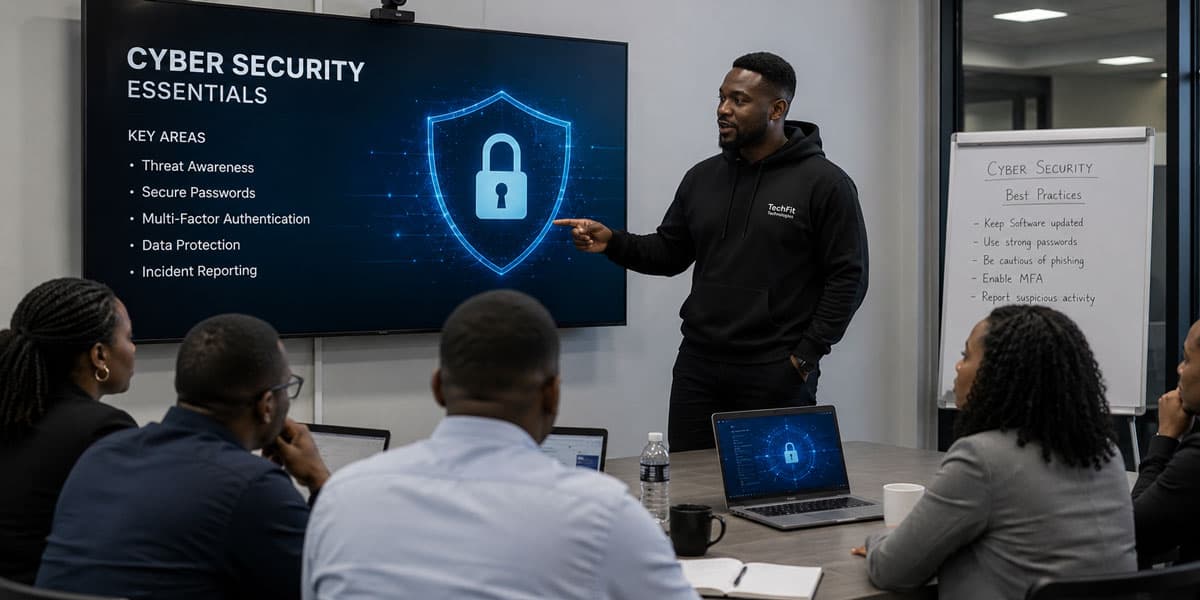
One Click Can Cripple Your Business: Why SMMEs Can't Ignore Cybersecurity Awareness
South African SMMEs are increasingly targeted by phishing, scams, and data breaches. Learn why cybersecurity awareness workshops are essential for protecting your business.
Read Article Cybersecurity
The Phone Scam South Africans Are Falling For: How Vishing Works and How to Stop It
Vishing, or voice phishing, is one of South Africa's fastest-growing cybercrimes. Here is how the phone scam works, why it is so effective, and exactly how to protect yourself and your business.
Read Article